

High Performance Without High Anxiety: Rebuilding a Founder’s Emotional Baseline
When “High Performing” Still Feels Unsafe
Some founders seem high performing from the outside and still feel unsafe on the inside.
They are productive. They make decisions. They carry the company forward.
But internally, they rarely feel settled.
There is always something running in the background.
The next problem.
The next risk.
The next decision.
The next person who needs reassurance.
The next thing that could go wrong.
Over time, this internal state can start to feel normal.
The founder may call it drive.
They may call it ambition.
They may call it being sharp.
They may even believe anxiety is what keeps them performing.
But there is a difference between being highly engaged and being constantly on edge.
There is a difference between caring deeply and living in a nervous system that never returns to baseline.
This is where founder anxiety becomes difficult to see clearly.
Because the founder may still be functioning well.
The company may still be moving.
The team may still trust them.
The results may still look strong.
But performance does not always mean the founder is internally well.
Sometimes a high performance founder is not calm.
They are performing on top of high anxiety.
And when that continues for too long, the founder may begin to confuse emotional activation with leadership capacity.
The real question is not whether the founder can keep performing.
The deeper question is whether they can perform without needing anxiety to feel in control.
The Myth That Anxiety Is the Price of Performance
Many founders quietly believe anxiety is part of the cost of building something meaningful.
This belief does not come from nowhere.
Startup culture rewards urgency. Survival phases reward intensity. Early growth can make anxiety feel useful because it keeps the founder alert and responsive.
In a real crisis, that alertness can help.
But the problem begins when the founder starts treating anxiety as a permanent operating requirement.
They begin to fear that calm means complacency.
If I am not anxious, will I miss something?
If I feel settled, will I lose my edge?
If I relax internally, will the company slow down?
This is how anxiety gets mistaken for care.
The founder may believe the anxious state proves commitment. If they are worried, they must be responsible. If they are tense, they must be serious.
But anxiety is not the same as responsibility.
And inner chaos is not the same as high standards.
Anxiety can create short bursts of energy. It can sharpen attention and make a founder move quickly when something is genuinely urgent.
But it is not a sustainable fuel source for leadership.
Over time, anxiety does not simply create urgency.
It narrows perception.
It reduces patience.
It turns normal ambiguity into threat.
It makes the founder feel as if everything depends on staying internally activated.
That is not high capacity.
That is high activation.
And the two are not the same.
What an Emotional Baseline Actually Is
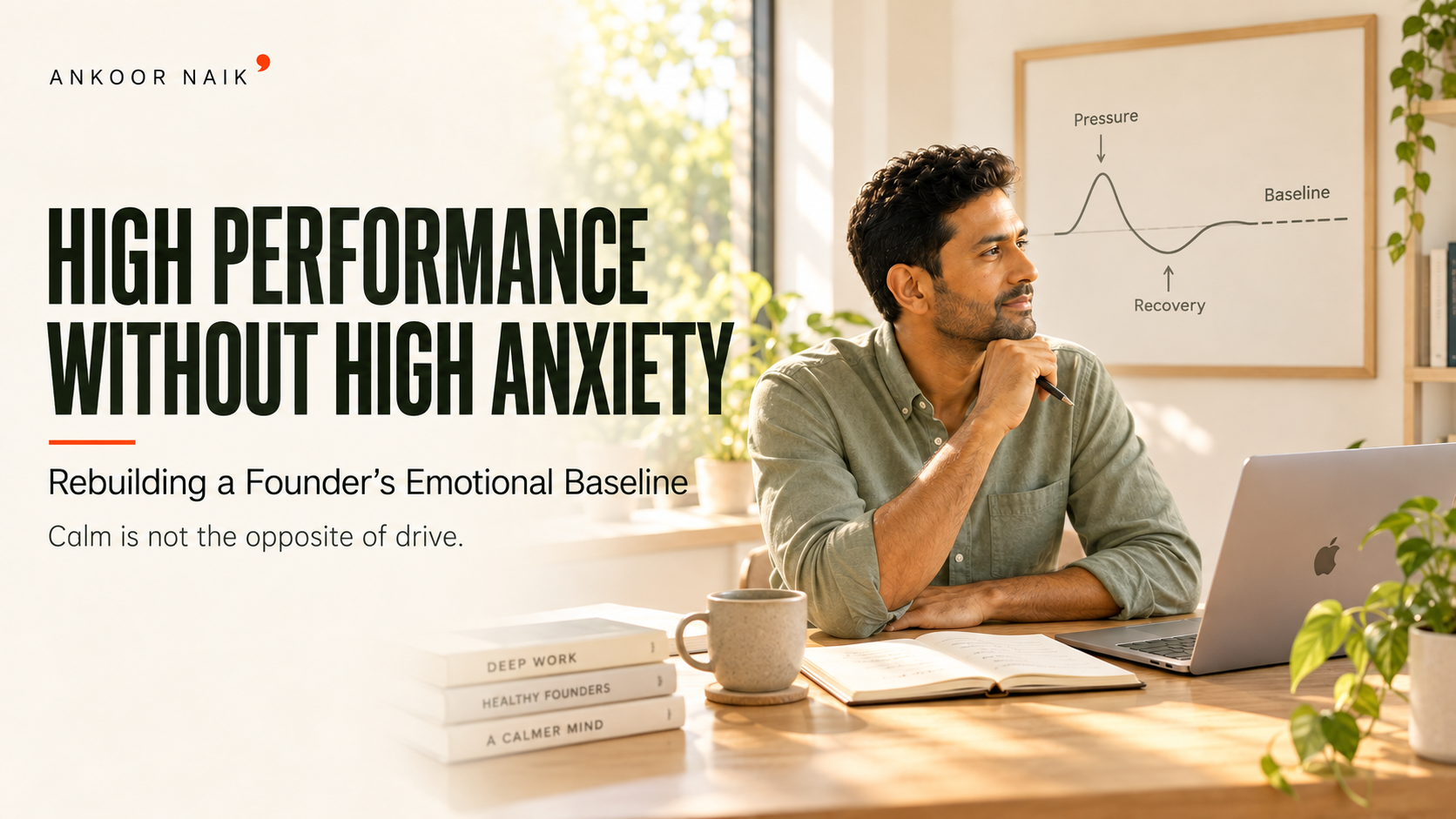
A founder’s emotional baseline is the internal state they return to when there is no immediate threat.
It is not constant happiness.
It is not permanent calm.
It is not detachment from the business.
It is the founder’s ability to come back to stable internal ground after pressure.
A hard conversation happens, and the founder eventually returns.
A setback lands, and the founder eventually returns.
A period of intensity passes, and the founder eventually returns.
That return matters.
Because without a baseline, every stressor becomes additive.
One issue does not end before the next begins. One difficult meeting leaves residue. One concern becomes a background loop.
The founder may keep functioning, but they stop recovering.
This is how many founders lose access to baseline entirely.
They do not notice it in one dramatic moment.
They notice it when calm starts feeling unfamiliar.
When rest feels suspicious.
When an empty hour feels uncomfortable.
When there is no immediate problem, but the body is still bracing.
When things are technically fine, but the founder still feels wired.
This is why rebuilding a founder emotional baseline matters.
It is not about becoming less ambitious.
It is about restoring the founder’s ability to come back to themselves after pressure.
How Founders Drift Into Chronic Anxiety Without Noticing
Founder anxiety often becomes chronic slowly.
It does not always begin as panic.
It begins as alertness that never fully switches off.
Constant Threat Scanning
The founder starts anticipating the next fire before it appears.
They scan for weak signals. A delayed reply. A strange tone in a meeting. A dip in numbers. A customer hesitation.
Some of this is part of leadership.
Founders do need to see around corners.
But when threat scanning becomes constant, the nervous system stays in alert mode even without an immediate crisis.
The founder is not only responding to problems.
They are living as if a problem is always about to happen.
That state is exhausting because the body does not experience it as strategy.
It experiences it as danger.
Internalized Pressure
At first, pressure may come from outside.
Investors. Customers. Deadlines. Payroll. Team expectations.
But over time, those external pressures become internal.
The founder no longer needs someone else to create urgency.
The urgency is already inside them.
Even when things are fine, the founder may feel behind. Even when the calendar is lighter, the mind remains occupied.
This is internalized pressure.
The off-switch disappears.
And when there is no off-switch, the founder may begin to believe that anxiety is simply who they are now.
Loss of Self-Trust
The third drift is loss of self-trust.
The founder begins relying on anxiety to feel in control.
If they are anxious, they feel vigilant.
If they are tense, they feel prepared.
Calm starts feeling risky because calm is no longer familiar.
This creates a strange loop.
The founder wants relief from anxiety, but also fears who they would become without it.
They may wonder:
Would I still care enough?
Would I still move fast enough?
Would I still perform?
This is where reducing founder anxiety becomes deeper than stress relief.
It becomes a question of self-trust under load.
Can the founder trust themselves to lead without needing constant internal panic?
High Anxiety Is Not the Same as High Capacity
High anxiety and high capacity can look similar from the outside.
Both can produce movement.
Both can create intensity.
But internally, they are very different.
High anxiety is urgency without recovery.
The founder is activated, but not necessarily clear. They are moving, but not always from steadiness.
High capacity is different.
High capacity is pressure tolerance with a return to baseline.
The founder can carry difficult situations without becoming consumed by them. They can make hard decisions without staying emotionally flooded.
That difference matters.
Because anxiety can create movement, but capacity creates steadiness.
An anxious founder may push hard.
A high-capacity founder can sustain pressure without losing access to judgment and perspective.
This is the real distinction.
The goal is not to remove pressure from founder life.
The goal is to increase the founder’s ability to meet pressure without living inside anxiety as a default state.
Why Performance Does Not Actually Improve With Anxiety
Anxiety can make a founder feel more alert.
But feeling alert is not the same as leading well.
In short bursts, anxiety may help the founder respond quickly. It can create immediate energy. It can make a problem feel impossible to ignore.
But sustained leadership requires more than activation.
It requires range.
The founder needs to think clearly, hold ambiguity, regulate emotional reactions, and choose responses that fit the situation.
Chronic anxiety reduces that range.
It narrows attention toward threat. It can turn delay into danger, disagreement into resistance, and uncertainty into failure.
This affects decisions.
An anxious founder may overcorrect.
They may rush decisions to reduce discomfort.
They may read too much into small signals.
It also affects relationships.
Anxiety leaks.
It can leak into the tone of a meeting, the way feedback is given, or the pressure the team starts feeling even when nothing has been said directly.
For related thinking on protecting judgment under pressure, see: Mental Clarity for Founders.
The point is not that anxiety makes founders weak. The point is that anxiety is a signal, not a leadership strategy.
When the signal becomes the operating system, performance becomes more frantic than steady.
Rebuilding a Founder’s Emotional Baseline
Rebuilding a founder’s emotional baseline is not about becoming passive.
It is not about losing ambition.
It is not about convincing the founder to care less.
It is about allowing the founder’s system to experience safety without interpreting safety as a loss of edge.
This matters because many founders do not actually fear calm.
They fear what calm might mean.
They fear it means they are no longer hungry.
They fear it means they are becoming soft.
They fear it means they will stop noticing risk.
But calm is not the opposite of drive.
Calm is what allows drive to become sustainable.
A founder can be calm and ambitious.
A founder can be steady and intense.
The work is separating threat from responsibility.
Responsibility says, “This matters, and I will respond.”
Threat says, “If I do not stay activated, everything may fall apart.”
Those are very different internal states.
One creates grounded leadership. The other creates chronic anxiety.
Rebuilding baseline means learning to operate without internal panic as the proof of seriousness.
It means the founder can still care, still make hard decisions, and still carry pressure without using anxiety as proof that they are doing enough.
This is not a technique. It is emotional regulation for founders at the level of identity and pressure.
What Changes When the Baseline Returns
When a founder begins returning to baseline more often, the change may not look dramatic from the outside.
But internally, leadership starts to feel different.
Decisions feel cleaner.
Not necessarily easier.
But cleaner.
The founder can separate the facts of a situation from the emotional charge around it. A problem can be serious without becoming total.
Pressure also becomes more tolerable.
The founder may still feel stress, but it does not automatically become overwhelm.
This changes performance too.
Performance becomes steadier, not frantic.
The founder is not relying on anxiety to create motion. They are operating from a more stable base.
That kind of performance is less dramatic, but more sustainable.
It also reduces the risk of burnout.
Because burnout often begins when the founder keeps spending emotional capacity without returning to baseline.
For a deeper look at this capacity lens, see: Burnout Prevention for Founders.
Calm Is Not the Opposite of Drive
High performance founders do not need inner chaos to lead well.
They need range.
The range to move fast when needed.
The range to care deeply without becoming consumed.
The range to carry responsibility without turning every moment into threat.
Anxiety may feel useful because it creates activation.
But activation is not the same as sustainable leadership.
A founder can be serious without being constantly anxious.
A founder can be driven without being internally unsafe.
A founder can perform at a high level without keeping their nervous system in alarm mode.
This is why reducing founder anxiety is not about lowering ambition.
It is about rebuilding the emotional baseline that allows ambition to last.
Calm is not complacency.
Calm is not carelessness.
Calm is not the absence of standards.
Calm is the ground from which a founder can see more clearly, respond more cleanly, and lead without making anxiety the cost of performance.
For founders who have been high performing but constantly wired, the invitation is not to stop caring.
It is to stop confusing anxiety with proof that they care.
Because high performance does not require inner chaos.
And sustainable leadership is not built by staying anxious forever.
It is built by learning how to return.
